Carb Cycling for Fat Loss: A 7 Day Template
A practical, plug-and-play 7-day carb cycling template for fat loss, including how to set high and low day macros, match carbs to strength training, and log everything easily in a calorie tracker.
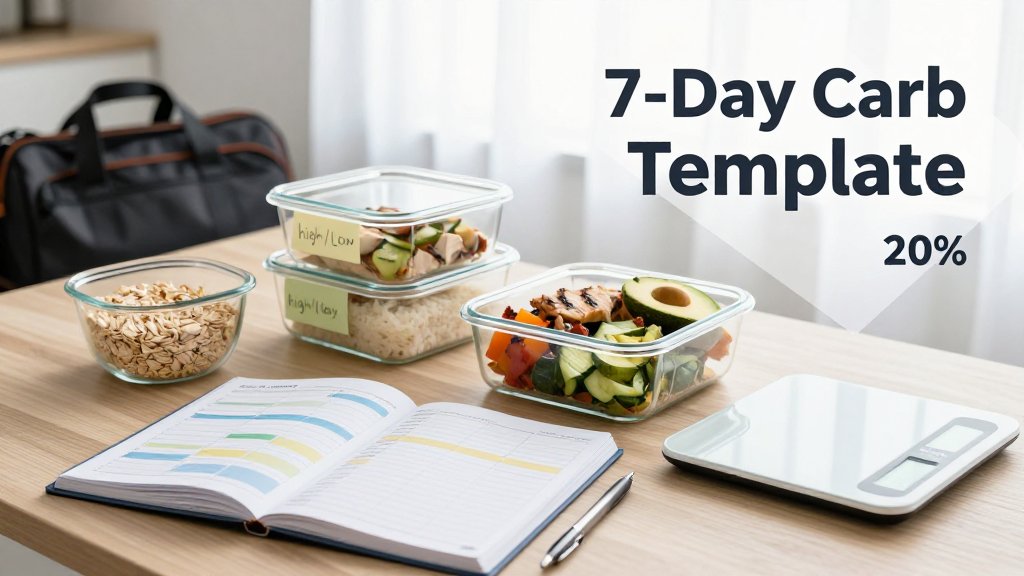
You are training hard, eating “pretty well,” and yet the scale will not budge. That stall is frustrating, especially when your workouts feel tougher than ever. Carb cycling offers a simple fix: place more carbs where they help most, around your hardest training days, while still keeping a weekly calorie deficit for fat loss. In this guide, you will learn how carb cycling works, how to pick high-carb and low-carb days, and how to follow an easy 7-day template you can log in any tracking app.
What carb cycling means for fat loss

Carb cycling is simply changing how many carbs you eat across the week instead of eating the same macros every day. You plan higher-carb days when you need more “fuel” (usually hard training days), and lower-carb days when you need less (usually rest days or lighter workouts). The goal is not to eliminate carbs, it is to place them where they feel most useful. A higher-carb day might include oats at breakfast and rice at dinner, while a lower-carb day might swap some of that starch for extra veggies, lean protein, and healthy fats. Same person, same foods, just different amounts on different days.
For fat loss, the real driver is not carb timing or a magic macro split. It is your weekly calorie deficit. You lose fat when, over time, you consistently take in fewer calories than you burn. Carb cycling can be a helpful structure, but it does not change the basic math. This is why research reviews on dietary treatment consistently come back to the same theme: weight loss happens when calorie intake is reduced relative to energy needs, regardless of whether the diet is higher-carb or lower-carb (see the Endotext obesity diet review). Think of carb cycling as a strategy for comfort and performance while you stay in that weekly deficit.
The one rule that makes carb cycling work
“Carb cycling only works for fat loss if your weekly calories stay in a deficit.” That one sentence clears up most confusion. Carbs are a dial, not a free pass. If your maintenance is 2,200 calories per day (about 15,400 for the week) and you want a weekly deficit of 2,100 calories, your target week might be around 13,300 calories. Now say you choose three high-carb training days and you accidentally eat 300 calories over maintenance on each (2,500 instead of 2,200). That is +900 calories across the week. To keep the week in the negative, you must create that gap somewhere else, for example, by eating about 150 calories less on six days, or about 300 calories less on three days. The week decides your fat loss, not the label on the day.
The most common carb cycling mistake is making high days too high and low days too low. That swing often turns into a binge-restrict loop: you “earn” a huge high-carb day, overshoot by 800 to 1,200 calories, then try to fix it with a low day that feels like punishment. A better approach for beginners is boring on purpose. Keep protein steady, keep veggies present, and adjust carbs in a range you can repeat next week. If tracking feels overwhelming, simplify your logging by using obvious package cues like serving size and calories, and lean on front-of-pack calorie labels to stay consistent even on busy workdays.
Plan your carbs around your schedule, not your cravings. If the week still averages a deficit, higher-carb training days can feel great. If the week averages a surplus, carb cycling becomes carb overeating.
Who should and should not carb cycle
Carb cycling tends to fit best if you lift 3 or more days per week, you have a couple genuinely hard sessions (heavy lower body, intervals, long runs), or you simply hate feeling low-carb every day. Here is what it looks like in real life: Jordan trains Monday, Wednesday, and Friday after work, plus a Saturday morning session. On training days, Jordan feels better with a higher-carb lunch and dinner, like a turkey sandwich with fruit at noon (about 600 calories), then a post-gym bowl with 5 oz chicken, 1 cup cooked rice, salsa, and veggies (about 650 to 750 calories). On rest days, Jordan keeps calories similar or slightly lower, but swaps some starch for volume, like a big salad with salmon, beans, and olive oil, plus Greek yogurt and berries. Energy is steadier, workouts feel stronger, and sticking to the plan becomes easier.
Carb cycling is not ideal if you do not track at all, if you have a history of disordered eating patterns, or if “high day” tends to turn into an uncontrolled free-for-all. It is also a poor fit if your schedule is unpredictable and you cannot reliably keep high days within a reasonable calorie ceiling. In those cases, you will usually do better with steady macros (same calories and protein every day) or one moderate refeed day that is planned, logged, and kept close to maintenance. Also, carb cycling is not a way to cancel overeating. If you blow past your target by 1,000 calories, calling tomorrow a “low-carb day” does not erase it, it usually just makes you hungrier. If any health condition affects your nutrition (for example diabetes, pregnancy, or GI issues), check with your clinician before changing macros.
How to set macros for high and low days
Carb cycling gets simple fast if you set things in the right order. Set protein first, set weekly calories second, then slide carbs up and down while keeping fats in a sensible range. That is it. High days are not a free-for-all, they are just days where you trade some fat calories for more carbs so training feels better. Low days are not zero carb days, they are simply less starch and more vegetables and higher-protein foods so you can keep your weekly deficit intact. If you log in a tracker, you will only need three numbers for each day: calories, protein grams, and fat grams. Carbs become the leftover.
Step 1: Lock in protein and weekly calories
Protein stays consistent across all days, because it protects muscle while dieting. A practical target for most fat loss phases is about 0.7 to 1.0 grams per pound of goal body weight (pick the lower end if you feel too full, pick the higher end if hunger is your main issue). This lines up well with sports nutrition research that commonly recommends higher protein intakes for active people, especially during energy restriction, such as the ranges summarized in the ISSN protein position stand. Example: if your goal weight is 170 lb, start with 140 to 170 g protein daily, then adjust for comfort and consistency.
Protein stays consistent across all days, because it protects muscle while dieting. Set it first, hit it daily, and let carbs and fats do the cycling so your training performance and hunger stay manageable.
Next, build the plan around weekly calories, not “perfect” daily macros. A realistic deficit for many people is about 10% to 20% below maintenance. If your maintenance is roughly 2,200 calories per day, that is 15,400 per week. A 15% deficit is about 13,100 per week. Now you can distribute those calories across your week so high days do not erase progress. For example, you might do 2 high days at 2,300 calories (heavy lifting days) and 5 low days at 1,700 calories (rest or lighter days). A common mistake is stacking an aggressive calorie deficit with very low carbs, which often makes training feel awful and cravings feel loud by day three.
Step 2: Set fat minimums, then move carbs
Think of fat as the floor and carbs as the slider. Your fat target keeps meals satisfying and makes it easier to build a routine, especially on low days. A simple range that works for many adults is 20% to 35% of daily calories from fat, with a sanity check minimum of about 0.3 grams per pound of goal body weight. For a 170 lb goal, that minimum is about 50 g fat. You can go a little higher on low days to make food feel less “diet-y,” then go a little lower on high days to make room for carbs, without blowing up total calories.
Once calories, protein, and fat are set, carbs are pure math. Use this plug-and-log formula: carbs calories = total calories minus (protein grams x 4) minus (fat grams x 9). Then carbs grams = carbs calories divided by 4. Using the sample above, set protein to 160 g every day (640 calories). On a high day at 2,300 calories, set fat to 55 g (495 calories). Carbs calories = 2,300 minus 640 minus 495 = 1,165, so carbs = 291 g. On a low day at 1,700 calories, set fat to 75 g (675 calories). Carbs calories = 1,700 minus 640 minus 675 = 385, so carbs = 96 g.
What “high” and “low” look like in real life is mostly a starch swap. Low day usually means fewer dense starches, more fibrous carbs, and a little more added fat: think 2 eggs plus egg whites, a big salad with chicken, Greek yogurt, salmon, berries, roasted broccoli, and a measured spoon of olive oil. High day usually means you keep protein the same, keep fats moderate, then bring back easy carbs around training: oats with banana, rice or potatoes with lean meat, a bagel post-lift, fruit, and low fat yogurt. If you want a simple guardrail, keep high day fats mostly in the 45 to 65 g range for many people, because fats add calories fast.
To make this stick, set up two day templates in your tracker (one high, one low) and reuse them. Log protein first at breakfast so the day does not get away from you. Then decide if today is high or low based on your training plan and schedule, not on your mood. If you lift after work, you can also tighten your recovery routine by reading post workout nutrition logging tips and using that same meal as your “high day anchor.” Give the plan 14 days before changing anything. If weight is not trending down and adherence is solid, reduce weekly calories by 100 to 200 per day, or pull 25 to 40 g carbs from low days.
A simple 7 day carb cycling schedule
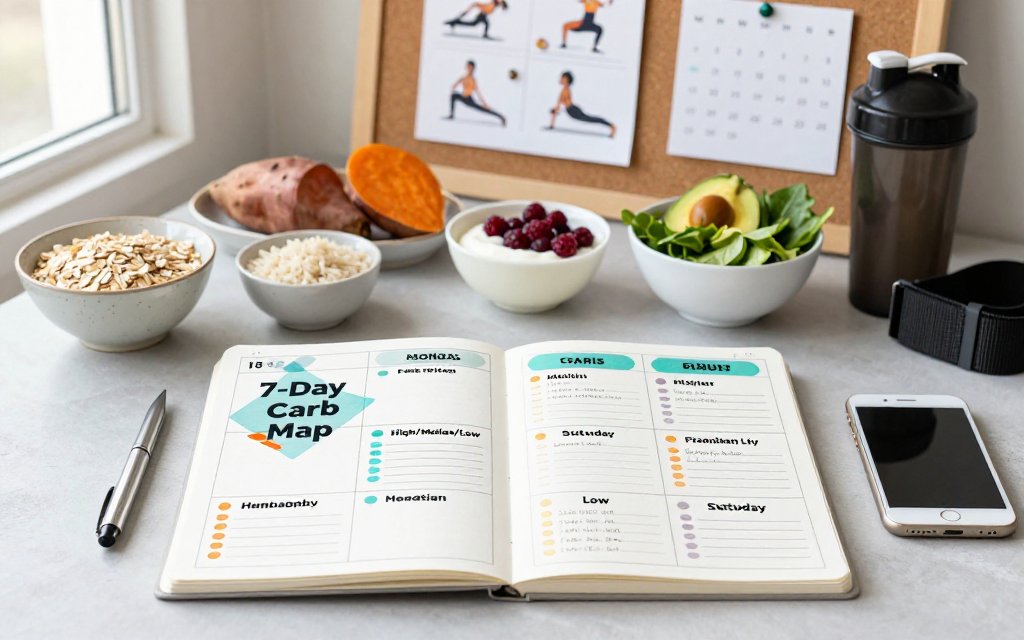
If your calendar is already packed, carb cycling only works if it feels plug-and-play. The easiest way to set it up is to choose your training days first (the days you will actually lift), then assign carbs based on how demanding the workout is. High-carb days go on your hardest strength sessions because carbs refill muscle glycogen and make it easier to push volume and intensity. Medium-carb days support lighter training and recovery. Low-carb days are for true rest days or light walking. Your weekly calorie average still matters most for fat loss, so think of carb cycling as moving the same weekly calories and carbs around to match effort, not as a license to eat wildly on high days.
Weekly carb cycling schedule for strength training
Use this simple rule as your anchor: “Put your highest carbs on your toughest lifting days, not on your easiest days.” That matches how most people feel in real life, too. Heavy lower body sessions (squats, deadlifts, high-rep leg work) tend to be the most glycogen-hungry and the most likely to suffer when carbs are too low. Research reviews on nutrient timing also support carbohydrate plus protein around training to help replenish glycogen and support adaptation, which is why high days fit best on your hardest sessions, not on rest days. If you want a deeper evidence overview, the ISSN nutrient timing position stand is a solid read.
This template is intentionally flexible. If your toughest lift day is Tuesday, shift the first high day there and slide the rest forward. The principle stays the same: hardest training gets the most carbs. Keep your protein target steady every day (for example, 140 g daily), keep your workout schedule consistent, and only move the carb portions. For busy weeks, a practical “minimum effective” version is: 1) lock in 2 to 4 lifting days, 2) label the hardest 2 or 3 as high days, 3) label the rest as medium or low based on how much you sweat and how sore you get.
Different splits fit cleanly into the same framework. If you lift 3 days per week, run 2 high days (your two toughest sessions), 1 medium day (your easiest lift), and keep the other 4 days low. If you lift 4 days, use 2 high (heaviest lower and heaviest upper), 2 medium (hypertrophy or accessories), and 3 low. If you lift 5 days, most people do best with 3 high (top priority days), 2 medium (pump or technique days), and 2 low (rest). The point is not perfection. It is matching fuel to training so you can keep strength up while dieting.
Real food examples for high, medium, and low days
On high-carb days, build meals around 2 to 3 “carb anchors” you can measure and log fast, plus fruit. Example high day (about 2,050 calories for someone averaging 1,850 weekly): breakfast oats (60 g dry oats) mixed with Greek yogurt and a banana; lunch chicken and rice (6 oz chicken, 1.5 cups cooked rice, salsa, peppers); dinner lean beef tacos (6 oz 93% lean beef, 3 to 4 corn tortillas) plus a side of pineapple. If you train after work, push a bigger carb anchor to the meal before or after lifting, then keep the rest of the day balanced.
Medium days are where people either accidentally under-eat (then raid snacks at night) or accidentally eat like a high day. Keep protein identical, keep fats moderate, and simply cut carb portions. A medium day might look like: eggs plus a small bowl of oats (30 g dry) and berries; a turkey sandwich on whole grain bread with a side salad; salmon with 1 medium potato and asparagus; and a protein-forward snack like cottage cheese. Low days are the swap: more veggies and protein, fewer starchy carbs. Think chicken salad, tofu bowls with cauliflower rice, eggs with spinach, salmon with broccoli, and beans in smaller portions (like 1/3 to 1/2 cup).
Plan the week like a budget: hit your protein and calories daily, then move carbs to match training stress. If one day goes off script, adjust the next day, do not restart Monday.
Social meals are easier when you use one simple restaurant rule: choose one main carb, not three. For example, at a burger place you can keep the bun and skip fries, or skip the bun and keep fries, but not both plus dessert. If you know a social meal is coming, make that day a high or medium day on purpose, then keep the earlier meals lean and protein-forward (Greek yogurt, egg whites, grilled chicken salad). If the social meal lands on a planned low day, you do not need to “ruin the week.” Swap: turn that day into a medium day and make the next day low. If you have medical concerns or a history of disordered eating, check in with a clinician before trying any cycling approach.
How to track, adjust, and avoid mistakes
Carb cycling only “works” if your weekly calorie deficit stays intact, and the easiest way to protect that deficit is to track like a realist, not like a robot. Weigh yourself daily (same time, after the bathroom), log most foods most days, and judge progress by trends. In CalMeal (or any tracker), aim for consistent portions: a food scale for rice, pasta, granola, nut butter, and cooking oils can fix the biggest logging errors fast. A common mistake is treating high-carb days like cheat days. Your high day should be planned, logged, and still within your weekly budget, just with more carbs and less fat.
Carb cycling macro tracking that actually works
Track weekly averages, not perfect days. Your minimum effective tracking order is: hit protein, stay within calories, then get carbs and fats close. If you can only do one thing today, pre-log your next high day before it happens, especially if it includes a social meal. Example: you know Saturday dinner is sushi, so you pre-log 2 cups cooked rice, 8 oz salmon or tuna, edamame, and fruit, then you keep breakfast simple (Greek yogurt plus berries). To reduce decision fatigue, repeat 2 to 3 “default” meals on low days, like chicken salad wraps, egg scrambles, or a protein shake plus oats.
If the scale spikes after a salty restaurant meal, do not slash calories the next day. Look at your 7-day average and your 14-day trend, then adjust only if the trend truly stalls.
Adjustments should be slow and boring. If your 14-day weight trend is flat (and your steps and logging have been consistent), reduce weekly calories by about 700 to 1400 total (that is roughly 100 to 200 per day equivalent), or pull 25 to 50 g of carbs from two low or medium days. Do not “fix” a stall by cutting protein. Keep protein fixed (for many people, 0.7 to 1.0 g per pound of goal body weight is a solid target), then manipulate carbs and fats to fit calories. Research on self-monitored weight loss often uses weekly average weights to evaluate trajectories, which is a good reminder to trust the trend, not the single weigh-in (weekly average weight trend). (nature.com)
Do I need a high carb day every week to lose fat?
No. Fat loss comes from a weekly calorie deficit, not from a specific “refeed” schedule. A high-carb day is a tool for performance, adherence, and social life. If you train hard on Tuesday and Friday, those can be your higher-carb days. If you feel great on steady carbs, you can skip high days and keep a simpler plan. If hunger is worst on weekends, place your higher-carb day on Saturday, keep protein the same, and lower fats earlier that day so calories stay on target.
What should high carb day macros and low carb day macros look like?
Keep protein constant across all days, then move carbs up and down while fats flex to match calories. Example for a 180 lb person aiming for fat loss: protein 160 g daily. Low day: 1700 calories, carbs 90 g, fat about 65 g (think eggs, chicken, big salad, olive oil, berries). High day: 2300 calories, carbs 260 g, fat about 55 g (think oats, potatoes, rice, bagels, fruit, plus lean protein). Protein consistency matters for keeping meals satisfying and supporting lean mass, and a well-cited meta-analysis suggests benefits plateau around about 1.6 g/kg/day for muscle gains with resistance training (protein plateaus near 1.6 g/kg). (pmc.ncbi.nlm.nih.gov)
Can I do carb cycling without strength training?
Yes, but you will want a different reason for high days. Without lifting, high-carb days are mainly for adherence, higher-step days, or cardio sessions, not for chasing a muscle “pump.” Set your higher-carb day on the day you do the most activity (a long walk, a hike, a spin class), and keep the weekly calories the same either way. If you do not strength train, be extra consistent with protein, sleep, and daily movement so the scale trend reflects real progress. If you have any medical conditions, or your weight changes unexpectedly fast, check in with your doctor.
Ready to make this template work in real life? Start tracking your nutrition today and remove the guesswork from calorie counting. Download CalMeal for free and use AI-powered food recognition to log meals faster, stay consistent, and hit your weekly calorie targets. Get CalMeal on iOS or Android, then track your next meal and start building momentum.
Start Tracking Your Nutrition Today
Download CalMeal for free and take the guesswork out of calorie counting with AI-powered food recognition.