0 Calorie Cooking Spray, Track It Correctly
“0 calorie” cooking spray can still add up if you cook daily. Learn why labels can say zero, how many calories you likely spray per second, and the simplest accurate ways to log it (grams, seconds, or a default entry) so weight loss math stays honest.
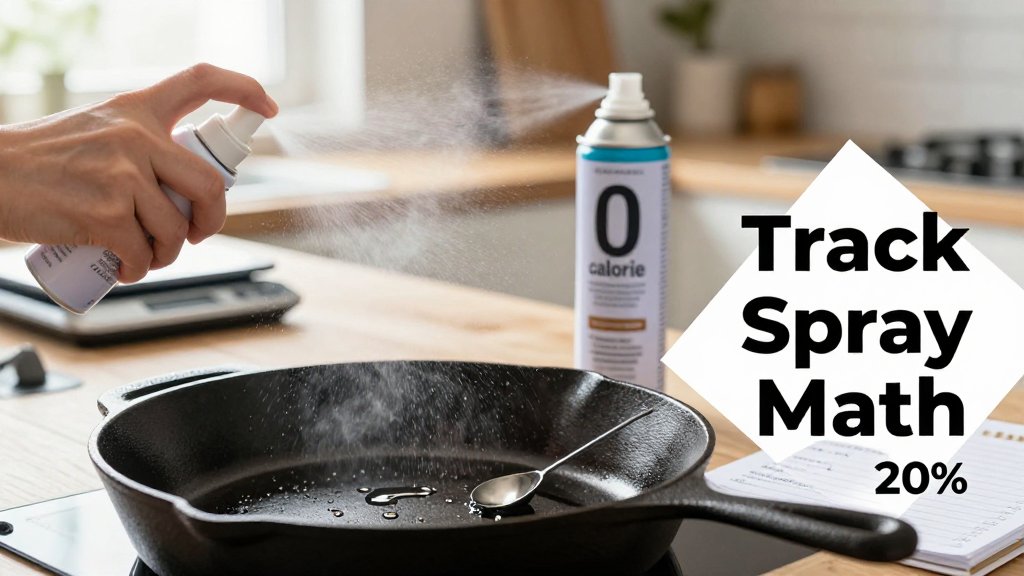
Cooking spray can be the tiny detail that quietly stalls fat loss, even when your tracking looks flawless. “0 calories” on the label does not always mean “no impact” in the pan, especially when servings are measured in fractions of a second. In this guide, you will learn how cooking spray labeling works, what you are actually adding to your food, and why it can add up over time. You will also get simple, realistic methods to track it accurately without slowing down dinner.
Is cooking spray really zero calories
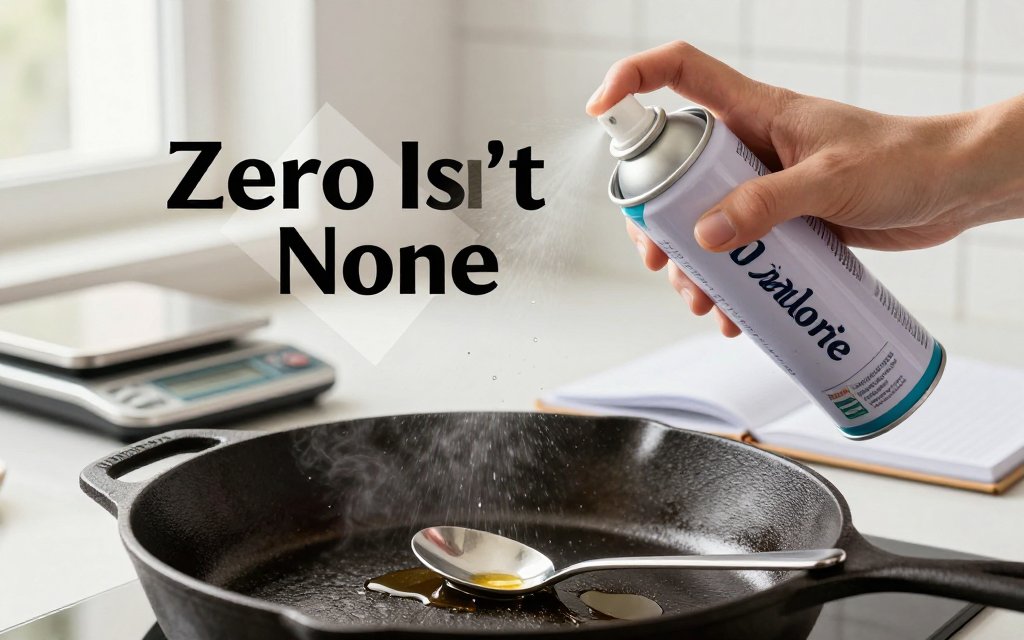
Most cooking sprays are still oil, and oil always has 9 calories per gram. That is the practical truth you can quote and build your tracking habits around. A can might look like a magic “0 calorie” shortcut, but it is not a physics loophole. It is usually just a very small labeled serving size, plus rounding rules that let companies print a zero. If you are trying to lose weight with a small deficit (say 200 to 300 calories per day), even small “invisible” calories can slow your results because they are easy to repeat daily without noticing.
The label loophole in one sentence
Here is the loophole: if calories per serving fall under a small threshold, the label can round down, so the brand chooses an extremely tiny serving size. Under FDA rounding rules, amounts under 5 calories per serving can be expressed as zero, which is why many sprays define a “serving” as a fraction of a second. So “0 calories” usually means “less than a few calories per labeled serving,” not “none.” If you spray for 2 seconds, you are not having one serving, you are having several servings back to back, and each of those tiny servings can still contain real oil.
This is also why the Nutrition Facts panel often shows 0g fat. Similar rounding rules apply to grams of fat, so a small amount can be rounded down on the label even though it is still fat in your pan. In real life, most people do not spray for “a quarter-second.” They do a 1 to 3 second spray to coat a skillet, then another quick spray after flipping, then again on the baking sheet, and maybe once more for the air fryer basket. None of those moments feels like “adding oil,” so it is common to forget it while logging, then wonder why weekly progress looks a little slower than the math said it should.
Oil math that never changes
The constant that makes this easy is the same for every oil spray: pure oil is about 9 calories per gram. That means if your “quick spray” deposits 0.5 g of oil, that is about 4.5 calories. If it deposits 1 g, that is about 9 calories. If it deposits 3 g, that is about 27 calories. Compare that to a teaspoon of poured oil, which is roughly 4.5 g, or about 40 calories. Cooking spray is often less than pouring, but it can still land in the “worth counting” range if you use it multiple times per day. The only real question is how many grams you actually use, not what the front label says.
If you want to track it correctly without turning meal prep into a science project, pick one simple method and stick with it for two weeks. The most accurate home method is a quick weigh test: put your pan on a food scale, tare to zero, spray the way you normally spray, then read the grams added. (You can also spray onto a plate on the scale if your pan is too heavy.) Do that a few times and you will learn your personal “average grams per spray.” Then you can log it like any other oil. If you want to keep your post-training days consistent too, pair that habit with post-workout nutrition logging tips so your calories and macros line up with what you actually did in the gym.
How repeated sprays add up across a week
Let’s put numbers to the example that sneaks up on people: two 2-second sprays per day. Many cans define a serving as roughly a third of a second and around a quarter-gram of oil. If your 2-second spray equals about 6 servings, that can be roughly 1.5 g of oil, or about 14 calories. Two of those per day is about 28 calories. Over a week, that is about 196 calories, which is basically an extra small snack you did not plan for. Could it completely stall fat loss? Not by itself. But in a small deficit, this is exactly the kind of “it’s basically nothing” habit that can shrink a 250-calorie deficit into a 150-calorie deficit without you realizing it.
The goal is not to fear cooking spray, it is to be consistent. If you use it once in a while, it is fine to ignore it and focus on bigger rocks like portions, protein, and steps. If you use it daily, treat it like oil and track a reasonable estimate. A simple shortcut is to set a personal rule such as “I log 10 to 20 calories of spray oil per cooking session,” then adjust if your weigh test shows you are heavier-handed. And if you have medical concerns (like needing specific fat targets), talk with a doctor or registered dietitian so your tracking matches your health needs, not just the label.
How many calories per second of spray
If you have ever tried to answer “PAM spray calories per second,” you have probably noticed the problem fast: seconds are not a true measurement of how much oil actually lands on the pan. Two people can both spray for 1 second and end up with totally different amounts of oil on the cooking surface. Nozzle design changes droplet size and flow, propellant pressure changes how forcefully it comes out, and even the angle you hold the can affects whether oil sticks to the pan or floats off as mist. That is why “per second” is always going to be a best guess until you calibrate your own can and your own spray style.
The environment matters more than most people think. A warm pan can make droplets spread thinner, while a cold pan can make them bead up and roll, which changes what stays on the surface versus what runs to the edge. Distance is huge too: a 6 inch spray is more concentrated than an 18 inch spray, which produces more airborne fog and overspray. Surface texture also changes “what counts,” since a well-seasoned cast iron skillet may need less oil than a sticky stainless pan, and a ridged grill pan traps oil in grooves. So yes, labels may define a “serving” as a tiny fraction of a second, but your dinner is made by what lands, not what the label imagines.
A realistic calories per second range
A practical working estimate is this: many people land roughly 0.3 to 1.0 grams of oil per 1-second spray, depending on how they spray. Since pure fat is about 9 calories per gram (the standard “4, 4, 9” labeling factors for protein, carbs, and fat are even referenced in the 4-4-9 calorie factors used for nutrition labeling), that puts you around 3 to 9 calories per second. Guardrails help: if you use a quick “pssst” to coat a pan for one egg, you might be near the low end. If you do a long, close spray to cover a large skillet before chicken and veggies, you can easily hit the high end.
Your goal is not to find the perfect universal number, it is to be consistent first, then calibrate. If you want a simple default that keeps you honest without making cooking stressful, pick a middle value like 5 calories per second (about 0.55 g per second) and use it for a week. That alone is often enough to fix the common “mystery deficit” issue where calories look perfect on paper but weight loss stalls. Example: a 3-second spray at breakfast plus a 4-second spray at dinner can quietly add 35 calories per day at 5 calories per second, which is about 245 calories per week. That is not a dealbreaker, it is just worth tracking correctly.
> Think of spray like seasoning with oil: a quick tap is one thing, a slow sweep is another. Track a consistent “spray style” for a few days, then measure once. Consistency first, calibration second, and guessing becomes rare.
| Method | Use | Accuracy |
|---|---|---|
| Label serving | Rare spritz | Low |
| Seconds estimate | Most cooking | Medium |
| Weigh can | Cutting phase | High |
| Measure tsp oil | Baking | High |
Calibrate your can once, then stop guessing
If you want a personalized number you can reuse for months, do the quick “weigh the can before and after” test. Put a kitchen scale on the counter, set it to grams, and tare it if needed. Weigh your spray can and write the number down. Spray into your usual pan for exactly 2 seconds using your normal distance and motion, then reweigh the can. The difference is grams used; divide by seconds to get grams per second. Repeat this 2 to 3 times and average the results, because the first attempt is often shaky. Example: if the can drops 1.6 g after a 2-second spray, that is 0.8 g per second, which is about 7.2 calories per second. Now you have your number.
Once you have your grams-per-second, logging gets simple. Use the same pan distance you tested, count your spray time, then multiply: seconds x grams-per-second x 9 calories. If you are tracking in a calorie app, you can log it as calories (fast) or as grams of oil (more precise for macros). A small tip that keeps this accurate: if you visibly see oil pooling and you wipe it out with a paper towel, do not count that wiped oil as eaten. If your goals change later and you start increasing intake, that calibration number still helps you stay intentional during transitions like a reverse diet without regaining. If you have any health concerns or very specific dietary targets, it is always smart to check with a doctor or dietitian.
Three accurate ways to track spray oils
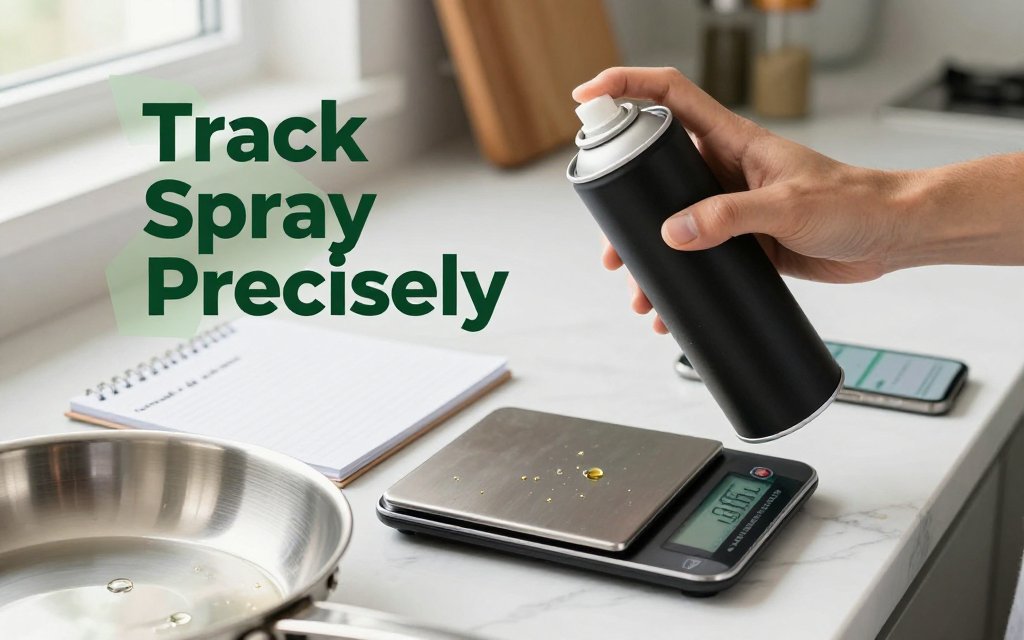
If you want accuracy, grams-based tracking wins. If you want speed, seconds-based tracking or a simple default entry can still work really well, as long as you do it the same way every time. The goal is not perfection, it is removing the hidden “maybe” calories that can quietly stall progress. Cooking spray is a perfect example because the label often says 0 calories, but your pan can end up with multiple grams of oil if you spray generously. Pick one method below, stick with it for two weeks, and your CalMeal trends will get a lot easier to trust.
The most common mistakes are simple: seeing “0” on the can and moving on, overspraying to prevent sticking, and switching brands without updating your estimate. Overspraying happens fast with sheet pans, air fryer baskets, and stainless skillets because you are trying to cover a large surface area. Brand switching matters because different nozzles and formulas can change how much comes out per second, plus some sprays include added emulsifiers or flavors. The good news is that you can solve all of this with one quick setup step, then log it in a way that matches your real cooking habits, not your best intentions.
Best accuracy: track grams of oil used
This is the gold standard because it measures what actually left the can. Put the cooking spray can on a food scale, note the grams, cook your whole meal (do not weigh after every spray), then weigh the can again at the end. The difference is your “grams used.” Log that as grams of oil (1 g oil is about 9 calories), or log it directly in CalMeal as an oil entry with the same gram amount. Many sprays list a tiny serving like “about 1/3 second (0.25 g)” and even show that it is not truly zero, for example serving size and calories for one popular buttery spray.
Real-life examples help. If you scramble eggs and do a quick, light mist in a nonstick skillet, you might use 0.5 g to 1 g total, which is roughly 5 to 9 calories. If you spray an air fryer basket thoroughly, especially the sides, it can be 1 g to 3 g (about 9 to 27 calories) before you even add food. Sheet pan veggies are where people accidentally go big: a few long passes across a large pan can easily hit 3 g to 6 g (about 27 to 54 calories), and then you might also add a drizzle of oil. Stir fry is another sneaky one if you “re-spray” between batches, the grams add up fast across the whole cooking session.
The best part about the grams method is that it fixes the overspray problem without you having to guess. It also protects you from brand changes because the scale does not care what nozzle you used. In CalMeal, you can keep it simple by creating a custom food called “Cooking spray oil” and logging grams, or by logging the closest match you already use (canola oil, avocado oil, olive oil) with the gram amount. Use this quick checklist for cleaner, more consistent logs, especially on weeks when you are trying to break a plateau.
You do not need perfect spray tracking to make progress. Choose one method, apply it consistently, and adjust only if results stall. A slightly “too high” estimate is often better than logging zero and guessing later.
Fast and consistent: seconds or a default entry
If the scale feels like too much, use seconds-based tracking with your own calibrated grams-per-second number. Calibration takes about 60 seconds: weigh the can, spray into a cold pan for exactly 2 seconds (count it out), weigh the can again, then divide grams used by 2. Now you have your personal estimate for that exact can and nozzle. Example: if 2 seconds used 1.0 g, then 1 second is about 0.5 g, and a typical quick “tap” of 0.5 seconds is about 0.25 g. In CalMeal, log “0.5 seconds spray” as 0.25 g, or just log grams directly for the day.
The lowest friction option is a default entry that matches your style. If you know you are heavy-handed, log “Cooking spray, 1 tsp oil equivalent” (about 4.5 g, roughly 40 calories) for any meal where you coat the pan or sheet. If you are light and mostly preventing sticking, log “Cooking spray, 1 g oil” (about 9 calories) and move on. This is especially useful for busy weeks because it keeps your database clean and your habits consistent. If fat loss stalls for two weeks, tighten the estimate upward before cutting food, and consider checking with a doctor if you have health concerns or a complex medical history.
Stop hidden oil calories from stalling weight loss
If your check-ins look like this, you are not alone: meals feel “clean,” portions are reasonable, steps are consistent, but the scale and measurements barely move. One of the most common culprits is tiny, repeated undercounting from cooking fats, especially sprays. For a taller, heavier person eating 2,500 calories, an extra 40 to 80 calories might not change the weekly trend much. For a shorter or lighter person maintaining around 1,600 to 1,900 calories, that same 40 to 80 calories can erase a big chunk of a modest 200 calorie daily deficit. That is the difference between slow progress and no progress.
A “0 calorie” label can still represent real energy from oil because rounding rules allow very small servings to display as zero. If you use multiple servings without realizing it, the math stops working in your favor.
Here is a simple troubleshooting rule that keeps you sane and consistent: if progress is slower than expected for 2 to 3 weeks, track cooking spray strictly for the next 14 days, then relax back to a repeatable default. “Strictly” means you choose one higher-accuracy method and stick with it (for example, weighing the can before and after cooking, or using a measured oil entry in grams). After two weeks, look at the trend. If your average weight drops faster and hunger is unchanged, your old spray assumption was probably too low. Lock in a slightly higher default and move on.
FAQ: Does 0 calorie cooking spray break a deficit
It can, depending on how much you use. Cooking spray is still oil, and oil is about 9 calories per gram. If your “quick spritz” turns into 3 to 6 seconds in the morning eggs, another few seconds for lunch chicken, and a longer spray for dinner veggies, you can quietly add dozens of calories per day. That matters most when your planned deficit is small, like 150 to 250 calories. Also, labels can show zero because of rounding rules (see the FDA Food Labeling Guide).
FAQ: Should I log cooking spray as oil or as spray
Log it as oil whenever you can, because nutritionally it behaves like oil. “Spray” entries are often tied to tiny serving sizes that round down, which is fine for labeling but messy for tracking. The cleanest, most transferable approach is grams of oil. One gram is about 9 calories, and common kitchen equivalents line up well (for example, 1 teaspoon of oil is roughly 4.5 g, about 40 calories). If you prefer household measures, you can sanity-check typical oil weights using a USDA household measure table.
FAQ: What is the easiest accurate default for beginners
Pick a default that prevents silent undercounting, then adjust after one quick test. If you are a light user (one pan, one quick spray), start by logging 1 gram of oil per cooking session (about 9 calories). If you spray frequently across multiple pans or you like a longer coat, start with a 1 teaspoon oil equivalent per day (about 40 calories). Then do a one-time “weigh test” at home: weigh the can, spray your typical amount for a meal, weigh again, and convert grams used to calories. Update your default and keep it consistent.
If you want the lowest-friction way to make this automatic, set a personal default in CalMeal and let the app do the repeatable math. Download CalMeal on iOS or Android, create a “Cooking spray (my default)” item, and choose the approach you will actually stick to (1 g per cook, or 1 tsp per day). For the next two weeks, be a little stricter and see what changes. After that, go back to your default and focus your energy on the big rocks like protein, fiber, and portions. For medical concerns or rapid weight changes, check in with a doctor or registered dietitian.
Ready to remove the guesswork from tracking, starting today? Download CalMeal for free and log meals faster with AI-powered food recognition, so hidden extras like cooking spray do not slip through the cracks. Build consistency, see clearer progress, and keep your calorie counts honest with less effort. Get CalMeal on iOS or Android and start tracking now.
Start Tracking Your Nutrition Today
Download CalMeal for free and take the guesswork out of calorie counting with AI-powered food recognition.