Prebiotic vs Probiotic Foods: Build a Gut-Friendly Deficit
Confused about prebiotics vs probiotics? This guide breaks down what they do, shares practical prebiotic and probiotic food lists, and shows how to hit fiber goals and log fermented foods so you can support gut health while staying in a calorie deficit.

“Gut-friendly” foods can help digestion, cravings, and consistency, but they are not automatically calorie-free. If you are trying to lose fat, you still need choices that support your deficit and your macros. In this guide, you will learn the simple difference between prebiotic and probiotic foods, plus real food examples with typical calories so you can plan intelligently. You will also get a practical tracking approach to build a gut-friendly deficit without blowing your daily targets.
Prebiotics vs probiotics, what matters for fat loss

You start taking your “gut health” seriously: a bottle of kombucha at lunch, a yogurt drink after dinner, maybe a probiotic gummy for good measure. Two weeks later the scale is stuck, and you are thinking, “Wasn’t this supposed to help me lose weight?” Here is the straight answer, early and quotable: Prebiotics and probiotics can support fat loss, but they cannot replace a calorie deficit. If that kombucha is 60 to 120 calories and it quietly becomes an add-on (instead of a swap), your deficit can disappear fast. Gut-friendly foods are a smart upgrade, but the basics still drive results: total calories, protein, and repeatable meal routines.
Where the gut piece does matter is how you feel while dieting. Better digestion regularity, fewer “snack spirals,” and meals that actually keep you full make it easier to stay consistent from Monday to Sunday. That is the real win for most people, adherence. Just keep your expectations realistic. You are not “resetting your metabolism” with kimchi, and you are not burning fat because a label says “live cultures.” Think of these foods as small tools that can make a deficit more comfortable, especially when you are busy, stressed, or cutting calories for the first time.
Prebiotics feed your gut, probiotics add microbes
Prebiotics are fermentable fibers and related compounds that your gut bacteria eat. The formal definition is detailed, but the practical meaning is simple: you eat the fiber, your microbes ferment it, and you may feel the benefits through digestion and appetite signals. A well-cited consensus definition describes a prebiotic as a substrate that is selectively utilized by host microorganisms and confers a health benefit. (nature.com) Probiotics are live microorganisms you consume in adequate amounts, usually through foods with live cultures or specific supplements. The NIH Office of Dietary Supplements summarizes the standard definition and also notes an important nuance, not all fermented foods qualify as probiotics. (ods.od.nih.gov)
A quick rule of thumb you can use at the grocery store: “plants and whole grains often bring prebiotics,” and “foods with live cultures can bring probiotics.” There is plenty of overlap, which is why a snack like plain Greek yogurt (probiotic potential if it contains live cultures) plus berries or a spoonful of oats (prebiotic fiber) can be a simple one-two combo. The most common mistake I see is chasing “probiotic” products while fiber stays low. People spend money on drinks and gummies, but their daily pattern is still low-fiber lunches, minimal beans or whole grains, and vegetables that show up only at dinner. That usually means hunger is still high, and dieting still feels hard.
If you want a gut-friendly deficit, start with the boring basics: build one high-fiber meal per day and one fermented add-on you genuinely enjoy. Track the calories, then let the gut benefits support your consistency.
How gut-friendly habits help you stay in a deficit
Fiber is the heavy hitter for appetite control because it adds volume and slows digestion, which tends to increase fullness. That does not mean “fiber melts fat,” it means higher-fiber meals can make it easier to eat fewer calories without feeling like you are white-knuckling your day. Research reviews commonly find that higher-fiber foods improve satiety signals compared with lower-fiber options, which can reduce later energy intake for some people. (pmc.ncbi.nlm.nih.gov) Practical calorie examples help here: swapping a 250-calorie pastry for a 200-calorie bowl of oatmeal made with 1/2 cup oats and topped with 1 cup berries often feels more filling, and it keeps you on budget.
Fermented foods can help in a different way, meal satisfaction and variety. If you actually like your meals, you repeat them more easily, which is the whole game in fat loss. Adding 2 tablespoons of sauerkraut (usually 5 to 15 calories) to a turkey sandwich, or putting kimchi on a rice bowl, can make a “diet meal” feel like real food. A serving of kefir might land around 120 to 180 calories depending on the brand and sugar, so it is better as a planned snack than a bonus drink. For a simple check, treat fermented items like condiments unless you have measured a serving and decided where those calories fit.
Another underrated benefit is digestion regularity, which matters for adherence even if it is not glamorous. If you feel bloated and unpredictable, you are more likely to skip planned meals, graze later, or quit tracking because “nothing makes sense.” A gut-friendly approach is to increase fiber slowly (for example, add one piece of fruit and one extra cup of vegetables per day for a week), drink enough water, and keep protein steady. If you have IBS, inflammatory bowel disease, or you are dealing with persistent GI symptoms, talk with a clinician before aggressively increasing fermentable fibers or adding multiple probiotic products at once.
If you like structured eating patterns, you can combine gut-friendly habits with time-based routines, just keep the deficit honest. Some people feel less hungry with fewer eating windows, but it is still easy to overdo calories with “healthy” add-ons like granola, smoothie bowls, or sweetened kombucha. If you are experimenting with eating windows and want a realistic take on whether it works without meticulous logging, read intermittent fasting without calorie tracking. The best plan is the one you can repeat weekly, with fiber-forward meals and fermented foods as supporting players, not the main event.
One last “keep it simple” strategy you can start today: pick one prebiotic-rich staple and one probiotic-style food you already enjoy, then build them into your normal meals without adding extra calories. For example, keep lunch calories the same but make it higher fiber: add 1/2 cup beans to a salad, switch to a whole grain wrap, or do an apple plus peanut butter instead of chips. For the probiotic side, choose something you will actually eat consistently, like yogurt with live cultures, kefir, or a small portion of fermented vegetables. If you want a credible definition and label reality check, the NIH probiotic definition is a solid reference. (ods.od.nih.gov)
Prebiotic foods list, fiber goals, and easy swaps
If you want a gut-friendly calorie deficit that feels sustainable, prebiotic foods are a cheat code. They tend to be high-volume, high-fiber foods that help you stay full on fewer calories, and they feed the beneficial microbes already living in your gut. The practical win is simple: more chew, more satisfaction, fewer “I need a snack” moments later. You do not need exotic powders or pricey “gut shots” to do this. You need a few repeatable ingredients, a realistic fiber target, and a slow ramp-up so your stomach stays comfortable while your habits get stronger.
Fiber goals for weight loss that people actually hit
A quotable guideline that works for most adults is: aim for roughly 25 to 38 g of fiber per day, and if you are currently low, increase by about 5 g per week. That 25 to 38 g range lines up with the “14 g per 1,000 kcal” Adequate Intake approach summarized in the Academy of Nutrition and Dietetics position paper on fiber, which also translates to about 25 g for women and 38 g for men in many calorie budgets (see 14 g per 1,000 kcal). If 25 to 38 g feels far away, adopt a minimum effective dose mindset: adding even +8 to +12 g per day is a noticeable win for fullness and meal quality.
Jumping from 10 g per day to 35 g overnight often backfires. The most common outcome is gas, bloating, and discomfort, followed by “fiber is not for me” and quitting. A smoother plan is to pick one meal per day to upgrade first, then stack upgrades. Week 1, add one high-fiber “anchor” (like lentils at lunch). Week 2, add a breakfast upgrade (like oats plus chia). Week 3, add a produce upgrade (like an apple with skin or a cup of berries). Hydration matters here: fiber works best when you also drink water across the day, especially around meals. If you track food in CalMeal, watch your weekly fiber average, not just a single day spike.
Treat fiber like progressive overload for your gut: add a little, hold steady, then add again. Consistency beats hero days. If your goal is fat loss, a steady +10 g daily increase can matter more than chasing perfection.
Prebiotic foods list you can use at breakfast, lunch, and dinner
Use the quick table below as a “no guessing” starting point. It is not meant to be perfect to the last calorie, because brands and cooked weights vary, but it gives you reliable ballparks for planning a deficit. The trick is mixing one or two of these into meals you already eat, rather than rebuilding your entire menu. Think swaps, not reinventions: oats instead of a pastry, beans added to a salad, chia mixed into yogurt, or cooled potatoes used in a potato salad style side with plenty of veggies and lean protein.
| Food | Serving | Fiber |
|---|---|---|
| Rolled oats | 1/2 cup, 150 kcal | 4 g |
| Lentils | 1/2 cup, 115 kcal | 8 g |
| Chickpeas | 1/2 cup, 135 kcal | 6 g |
| Chia seeds | 2 tbsp, 140 kcal | 10 g |
| Apple (skin) | 1 medium, 95 kcal | 4 g |
| Cooled potato | 1 cup, 130 kcal | 3 g |
Breakfast is the easiest place to rack up prebiotic-friendly fiber without blowing calories. Try 1/2 cup oats cooked with water or milk, then stir in 1 to 2 tablespoons chia and top with berries, or use a slightly green banana sliced on top for a more “starchy” bite. If you prefer savory, oats can be cooked like rice and topped with an egg, sautéed onions, and spinach. If you already eat yogurt, you do not need to change the yogurt first, just add fiber to it: mix chia into yogurt, add berries, and keep an apple nearby for crunch. That is a low-friction way to add roughly 8 to 12 g fiber to the day.
Lunch and dinner are where legumes do the heavy lifting. Add 1/2 cup beans to a salad, fold lentils into a soup, or build a quick bowl with barley, chickpeas, chopped cucumber, and a lemon-garlic dressing. Onions, garlic, leeks, and asparagus are “bonus” prebiotic add-ins because they are low-calorie flavor builders that can ride along with almost any meal. For a simple deficit-friendly template, make a big batch of bean-based lunches and portion them into containers. If you want a plug-and-play option, use dense bean salads macro math as your framework, then rotate the veggies and seasonings so you do not get bored.
For easy swaps that support gut comfort, focus on one upgrade per plate. Example: replace a white bread side with cooked and cooled potatoes or rice once or twice per week, then pair it with protein and a pile of non-starchy veggies. Cooling cooked starches can increase “resistant starch,” which acts more like a fermentable fiber. You can eat it cold (potato salad style) or reheat it and still keep some of that effect. Keep portions reasonable for your calorie deficit, like 1 cup cooked and cooled starch as a side, not the whole meal. If bloating shows up, reduce the portion, slow the ramp, and consider checking in with a clinician if symptoms persist.
Probiotic foods list, fermented food calories, and portions
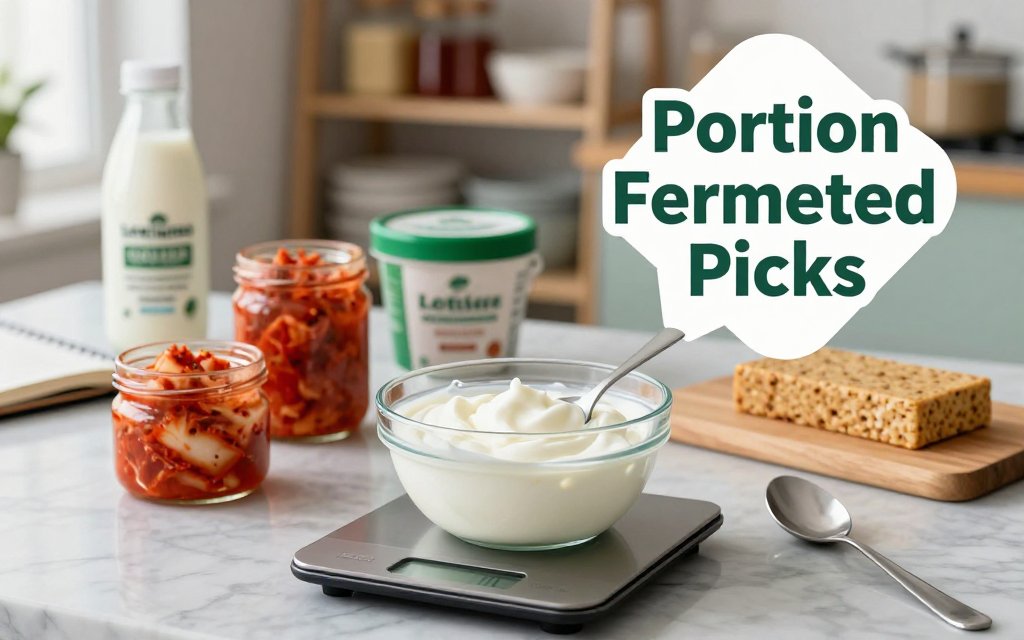
Fermented food has a “health halo,” so it is easy to assume it is automatically light. In reality, fermented just describes a process. Some fermented foods are low-calorie add-ons (kimchi, sauerkraut). Others are basically a full macro choice (tempeh). The sneakiest category is fermented drinks, because a “healthy” bottle can quietly stack calories the same way juice does. If your goal is a gut-friendly calorie deficit, you do not need to avoid fermented foods, you just need to treat them like any other food you track: pick the ones you like, set a portion, and repeat it so your daily numbers stay predictable.
Probiotic foods list that is worth your calories
Start with foods that are both realistic for your lifestyle and easy to portion. Yogurt with live cultures is usually the simplest place to begin, but label details matter. The FDA allows “contains live and active cultures” only when specific culture counts are met, and it also requires yogurts treated after culturing to say “does not contain live and active cultures.” That makes your job easier at the store, because shelf-stable or heat-treated products may not deliver live cultures even if they taste like yogurt. If you are dealing with a medical condition or are immunocompromised, it is smart to run fermented food choices by your clinician. (fda.gov)
Here is the rule that keeps this simple: prioritize probiotic foods you already enjoy, then standardize the portion so tracking stays easy. For example, decide that your “default” is either 170 g (about 3/4 cup) plain nonfat Greek yogurt, or 1 cup plain kefir, or 1/2 cup kimchi with dinner. Use the same bowl, cup, or scale weight for two weeks, and your deficit gets much easier to maintain because your gut-friendly add-on stops being a moving target. If you want to get picky (in a good way), the FDA yogurt labeling guide explains exactly what “live and active cultures” can mean on a label, and when products must disclose that cultures are not live. (fda.gov)
Track fermented foods like any other calorie source. Pick one probiotic you actually enjoy, measure a repeatable portion, and watch for sugary add-ins and big drink servings that can quietly add 200 calories.
Fermented foods calories, what to watch in the label
Kimchi calories per serving are often pleasantly low, but brands vary. A University of Arizona Cooperative Extension kimchi handout lists 15 calories in 1/2 cup of napa cabbage kimchi, which is why kimchi can be a high-flavor, low-calorie side. (extension.arizona.edu) Sauerkraut is similar in spirit but different in details: a Washington State University Extension sheet notes sauerkraut has about 44 calories per cup, so 1/2 cup lands around the low 20s. (s3.wp.wsu.edu) The myth-busting part is sodium and add-ins. Both are salty, and some kimchi includes sugar or oil. If you are watching blood pressure or have kidney concerns, check with your doctor about high-sodium foods.
Yogurt and kefir are where calorie differences can get sneaky fast. Plain options tend to be “boring but budget-friendly” for a deficit: they give you protein without the sugar spike. Once you move into sweetened yogurt, fruit-on-the-bottom cups, or drinkable kefir, calories can jump because sugar adds up and portions get large. As a concrete reference point, FatSecret lists 110 calories per 1 cup (240 ml) of Lifeway lowfat plain kefir. (foods.fatsecret.com) That is a reasonable add-on, but a 12 to 16 oz flavored bottle can easily be double that. Same story with yogurt parfaits: granola plus honey can turn “probiotic yogurt” into a dessert-level calorie load.
Fermented does not equal low-calorie, and tempeh is the perfect example. It is fermented and nutrient-dense, but it is a protein choice, not a condiment. A University of Washington nutrition handout lists about 196 calories per 3.5 oz serving of tempeh. (depts.washington.edu) Miso is the other common trap, not because it is huge in calories, but because it is easy to pour without measuring. One tablespoon of miso paste is around 34 calories, and most people use more than they think. (verywellfit.com) The practical fix is to keep fermented add-ons consistent: aim for about 2 tablespoons to 1/2 cup with meals, and measure miso with an actual tablespoon once so your “eyeballing” gets more accurate.
One more myth to retire: “fermented” and “probiotic” are not automatic synonyms. Some fermented foods in their final form may not contain live microorganisms, often because of heat treatment or filtering done for shelf stability. (todaysdietitian.com) That is why the label matters more than the vibe. If a product is shelf-stable and marketed for gut health, scan for specifics like “live cultures,” storage instructions, and ingredient cues (for pickles, brine-fermented is different from vinegar-only). If you stick to foods you already like and lock in a repeatable serving, fermented foods can support your routine without turning into calorie guesswork.
Image concept for this section: a simple “serving-size showdown” photo grid that shows (1) 170 g plain Greek yogurt in a bowl, (2) 1 cup plain kefir in a glass, (3) 1/2 cup kimchi in a ramekin, (4) 1/2 cup sauerkraut in a ramekin, and (5) 3.5 oz tempeh on a small plate. Add bold calorie callouts under each (for example, kimchi can be as low as 15 calories per 1/2 cup, sauerkraut about 44 per cup, tempeh about 196 per 3.5 oz). (extension.arizona.edu) The takeaway should be visual: some fermented foods are add-ons, others are the main protein.
How to track fiber and fermented foods in a deficit
A calorie deficit works best when your meals are repeatable and satisfying, not when you micromanage every gram of “healthy” food. My favorite mindset is: calories and protein are the non-negotiables, then fiber and fermented foods are gut supports that make the plan easier to stick with. For a practical fiber target, many guidelines use about 14 grams per 1,000 calories (so a 1,600 calorie cut would land near 22 grams). That reference shows up in the USDA fiber AI reference. If you are currently low, increase slowly and drink fluids to stay comfortable.
To keep tracking simple, use a consistent workflow and stop there. You are not trying to build the “perfect gut microbiome day.” You are trying to hit your deficit, support training recovery, and nudge your food choices toward higher-fiber plants and a little fermented food most days. In CalMeal (or any tracker), this means you log the big rocks first, then you add gut supports if they fit your calories.
A simple gut-friendly deficit template you can repeat
Build your day around “protein anchors,” then layer in plants. At breakfast, think Greek yogurt, eggs, cottage cheese, or a protein shake. At lunch and dinner, think chicken, tuna, tofu, tempeh, lean beef, beans, or lentils. Then add 1 to 2 high-fiber picks per meal (berries, chia, oats, beans, broccoli, popcorn, a high-fiber wrap), plus 1 fermented food most days. For example, you might do overnight oats (1/2 cup dry oats) with berries and chia, then pour in 1 cup kefir. Later, a big salad with 1/2 cup beans and a measured scoop of sauerkraut. Dinner could be a rice bowl with tempeh and a side of kimchi.
Consistency beats perfection, especially in a deficit. Keep portions trackable by using the same bowl, the same measuring spoon, and a couple of default entries you trust. Log the calorie dense parts precisely (oats, rice, oils, nuts). For fermented foods, you can be “consistent enough” with volume measures because calories are usually small, and the bigger issue is sodium and tolerance. If a food feels like it bloats you, reduce the serving and try again later, or talk with a clinician if you have gut symptoms you are worried about.
If logging starts to feel stressful, zoom out. Hit calories and protein, then treat fiber and fermented foods like bonus points. Two good meals and one gut-support snack beats one perfect day followed by quitting.
FAQ: prebiotics, probiotics, and logging common foods
Beginners usually get stuck on the same three questions: do you need probiotic supplements, do fermented foods “count” in a deficit, and how to track this without turning meals into math homework. Use the answers below as simple guardrails, not rigid rules. If you have IBS, IBD, take immunosuppressing meds, are pregnant, or have any medical concerns, check in with your doctor or a registered dietitian before making big changes to fiber, supplements, or fermented foods.
Do I need probiotics for gut health weight loss, or is fiber enough?
For most people dieting for fat loss, fiber-rich foods do more “heavy lifting” than probiotics because they add volume and help meals feel satisfying while you stay in a calorie deficit. Aim to hit your calorie and protein goals first, then build toward a steady fiber baseline (for example, 22 g if you eat about 1,600 calories). Add fermented foods for variety and enjoyment, not because you “must.” Probiotic supplements can be useful in specific situations, but results vary by strain and person, so ask your clinician if you want personalized guidance.
How many calories are in kimchi, sauerkraut, and probiotic yogurt?
Most fermented vegetables are “calorie light,” so the portion that fits your taste buds usually fits your deficit. For example, kimchi is about 16 calories per 1/2 cup based on kimchi nutrition facts. Sauerkraut is typically in the same ballpark (often around 10 to 30 calories per 1/2 to 1 cup), but sodium can be high, so measure it like a condiment (2 to 6 tablespoons). Probiotic yogurt varies the most: plain, high-protein tubs might be 90 to 180 calories per serving depending on fat and added sugar, so scan the label and log that one carefully.
What is the easiest way to track fiber and fermented foods daily?
Use a two-metric check-in: (1) did you hit your fiber number, and (2) did you include one fermented serving most days. In your tracker, pin a short list of “fiber heroes” you actually eat (oats, chia, black beans, berries, popcorn, broccoli), then build meals by adding one hero at a time. For fermented foods, log a default serving such as 1/4 cup kimchi, 1/4 cup sauerkraut, or 3/4 cup kefir, and keep it consistent. If you miss a day, do not “make up” for it, just return to the template tomorrow.
Ready to make gut-friendly choices that still fit your calorie and macro goals? Start tracking your nutrition today with CalMeal. Download it for free and take the guesswork out of calorie counting using AI-powered food recognition, so you can log faster and stay consistent. Get CalMeal on iOS or Android and start building your deficit with clarity.
Start Tracking Your Nutrition Today
Download CalMeal for free and take the guesswork out of calorie counting with AI-powered food recognition.