Lose a pound a week with a 500 calorie deficit
Cut about 500 calories a day and you can lose close to a pound a week. Here is how to find your maintenance calories, set a 500 calorie deficit, and keep the scale moving when it stalls.
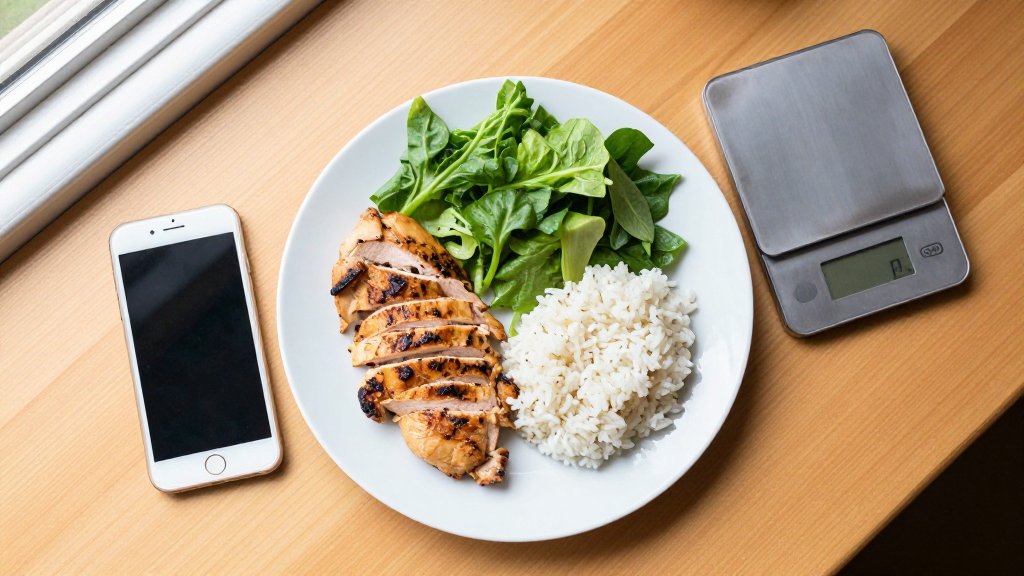
Trim about 500 calories a day and you can lose close to a pound a week. That single idea, a 500 calorie deficit, is the quiet engine behind almost every diet that actually works. You do not need a cleanse or a fad, you need to eat a bit less than your body burns, most days, for long enough to matter.
A calorie deficit for weight loss just means your intake sits below the calories you spend. Get the gap right and the scale moves. Too small and nothing happens, too big and you feel awful and quit. This guide shows how to find your number and hold it.
What is a calorie deficit, in plain terms
Your body burns energy all day, even while you sleep. Add up everything, basic organ function plus every bit of movement, and you get your maintenance calories, the amount that keeps your weight flat. Eat under that line and your body covers the difference from stored fat. That gap is the deficit.
So what is a calorie deficit in practice? It is not starving. A moderate gap of 500 calories a day is enough for most people to see steady change without white knuckling every meal. Portion size does a lot of the quiet work here, and our guide to healthy portion sizes is a good place to start.
About 3,500 calories equals one pound of fat, but your body rarely reads the math that cleanly.

How to calculate calorie deficit for your body
To determine calorie deficit numbers for yourself, start with maintenance. Most calculators use the Mifflin-St Jeor equation, which factors in your age, height, weight and activity to estimate your total daily burn. Cleveland Clinic guidance suggests subtracting 500 from that number as a sensible starting point.
Here is how to calculate a calorie deficit in four steps. None of it needs a spreadsheet, and a good food logging app can do the tallying for you.
The calorie deficit formula behind a 500 calorie deficit
The calorie deficit formula is simple arithmetic: maintenance calories minus your chosen deficit equals your daily target. Pick 500 and you have a 500 calorie deficit, the pace most dietitians point to first.
The 3,500 calorie rule, and where it bends
The old rule says a pound of fat holds about 3,500 calories, so a 500 a day gap should shed a pound a week. The Mayo Clinic notes that cutting 500 calories a day tends to bring half a pound to a pound off each week, not always the full pound.
Why the wobble? You lose a mix of fat, water and a little lean tissue, and a smaller body burns fewer calories over time. The math is a guide, not a promise, which is why weekly weigh ins beat daily ones.
| Daily deficit | Weekly loss | Pace |
|---|---|---|
| 250 cal | ~0.5 lb | Gentle |
| 500 cal | ~1 lb | Standard |
| 750 cal | ~1.5 lb | Brisk |
| 1000 cal | ~2 lb | Aggressive |
Cutting about 500 calories a day tends to take off half a pound to a pound each week.

How many calories should you eat a day
General guidance from the NHS puts average needs near 2,000 calories a day for women and 2,500 for men. Those are baselines for maintenance, not weight loss, and they swing with age and activity.
So how many calories should I eat a day to lose weight? Take your maintenance figure and drop it by 500. A woman maintaining at 2,000 aims for about 1,500, a man at 2,500 aims for roughly 2,000. That is the whole trick behind a sensible calorie deficit diet for weight loss.
A worked example for a 2,000 calorie day
Say a calculator pegs your maintenance at 2,000 calories. A 500 gap sets your target at 1,500. Swapping a sugary latte and a pastry for black coffee and Greek yogurt can cover most of that gap before lunch, and our Greek yogurt protein guide shows why it keeps you full.
| Group | Maintain | Lose 1 lb |
|---|---|---|
| Avg woman | 2,000 | 1,500 |
| Avg man | 2,500 | 2,000 |
| Active woman | 2,400 | 1,900 |
| Active man | 3,000 | 2,500 |
What a 500 calorie deficit looks like on the plate
Five hundred calories is less food than it sounds. It is often one snack and one drink, not a whole meal. Find it in the easy places and you barely notice the change.
Protein makes the deficit easier because it keeps hunger down for fewer calories. Lean meats do heavy lifting here, and our ranked high protein foods list shows the best picks per calorie.

Swaps matter more than sacrifice. Trading a big scoop of white rice for a smaller portion, or a soda for sparkling water, chips away at the total without a hunger fight. See the rice calorie comparison for one easy win.
Why the scale can stall on a calorie deficit diet
You set a calorie deficit diet, the weight drops, then it parks. This is normal. A lighter body burns less, so the same meals that once meant a deficit slowly become maintenance.
The fix is not to slash calories to nothing. Recalculate your target every 10 to 15 pounds lost, tighten your logging, and lean on a calorie deficit calculator or app to keep the number honest. A quick daily check with a calorie tracking app takes the guesswork out.

Common questions about a calorie deficit
How many calories to lose a pound?
The classic figure is about 3,500 calories per pound of fat, which is why a 500 a day gap targets roughly a pound a week. Real results vary with your size, sex and how much you have to lose. Treat the number as a starting estimate, then adjust from your own weekly trend.
Is a 500 calorie deficit safe for most people?
For many healthy adults, a 500 calorie deficit is a moderate, sustainable pace. Very low intakes, under 1,200 for women or 1,500 for men, are harder to hold and can shortchange nutrition. Anyone with a health condition should check with a doctor before starting.
Do I need a calorie deficit calculator?
A calorie deficit calculator speeds up the maintenance estimate, but it is only a starting point. Your real maintenance shows up after a week or two of honest logging and weekly weigh ins. The calculator gets you close, your own data gets you exact.
How many calories should I eat to lose weight?
Take your maintenance calories and subtract 500 for a steady loss of about a pound a week. For a lot of women that lands near 1,500 a day, and for many men closer to 2,000. Adjust up or down based on results, energy and hunger.
A 500 calorie deficit works best when the counting is effortless. Start tracking your meals today and take the guesswork out of a calorie deficit with AI food recognition, then watch the pound a week add up. Get the app here: iOS or Android.
Start Tracking Your Nutrition Today
Download CalMeal for free and take the guesswork out of calorie counting with AI-powered food recognition.